Latency Numbers
Latency Numbers, L1 Cache To Retry
From Alex Xu at ByteByteGo.
Alex Xu at ByteByteGo recently published “Which latency numbers should you know?”.
Let’s check it out.
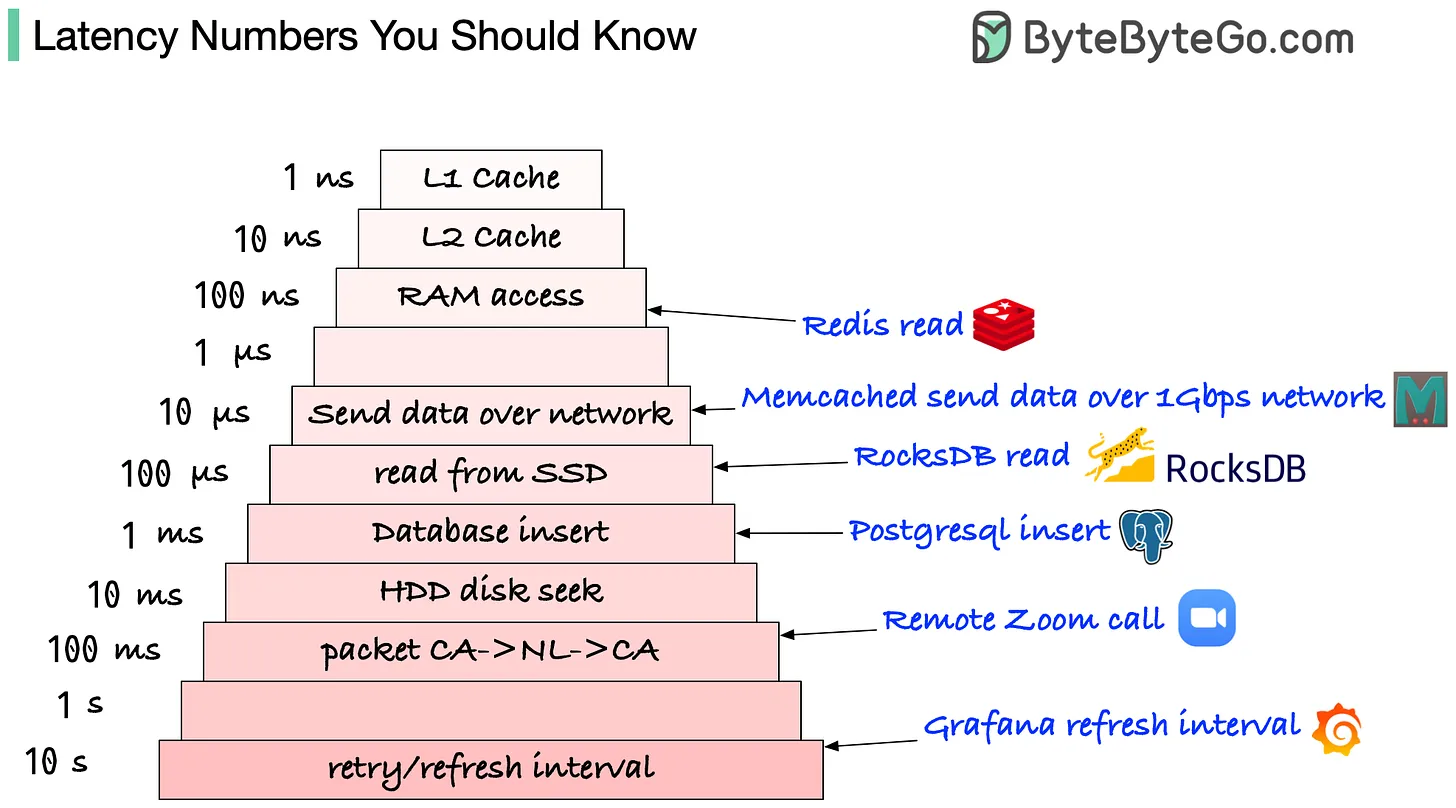
(These are based on some online benchmarks e.g. Jeff Dean’s latency numbers + some other sources).
-
L1 and L2 CPU caches: 1 ns, 10 ns E.g.: They are usually built onto the microprocessor chip. Unless you work with hardware directly, you probably don’t need to worry about them.
-
RAM access: 100 ns E.g.: It takes around 100 ns to read data from memory. Redis is an in-memory data store, so it takes about 100 ns to read data from Redis.
-
Send 1K bytes over 1 Gbps network: 10 us E.g.: It takes around 10 us to send 1KB of data from Memcached through the network.
-
Read from SSD: 100 us E.g.: RocksDB is a disk-based K/V store, so the read latency is around 100 us on SSD.
-
Database insert operation: 1 ms. E.g.: Postgresql commit might take 1ms. The database needs to store the data, create the index, and flush logs. All these actions take time.
-
Send packet CA->Netherlands->CA: 100 ms E.g.: If we have a long-distance Zoom call, the latency might be around 100 ms.
-
Retry/refresh internal: 1-10s E.g: In a monitoring system, the refresh interval is usually set to 5~10 seconds (default value on Grafana).
Notes
- 1 ns = 10^-9 seconds
- 1 us = 10^-6 seconds = 1,000 ns
- 1 ms = 10^-3 seconds = 1,000 us = 1,000,000 ns
An updated conversation about Latency times can be found here: https://gist.github.com/jboner/2841832
And a nice comprehension using solar system references is here:
| Operation | Time in Nano Seconds | Astronomical Unit of Weight |
|---|---|---|
| L1 cache reference | 0.5 ns | 1/2 Earth or Five times Mars |
| Branch mispredict | 5 ns | 5 Earths |
| L2 cache reference | 7 ns | 7 Earths |
| Mutex lock/unlock | 25 ns | Roughly [Uranus +Neptune] |
| Main memory reference | 100 ns | Roughly Saturn + 5 Earths |
| Compress 1K bytes with Zippy | 3,000 ns | 10 Jupiters |
| Send 1K bytes over 1 Gbps network | 10,000 ns | 20 Times All the Planets of the Solar System |
| Read 4K randomly from SSD* | 150,000 ns | 1.6 times Red Dwarf Wolf 359 |
| Read 1 MB sequentially from memory | 250,000 ns | Quarter of the Sun |
| Round trip within same datacenter | 500,000 ns | Half of the Mass of Sun |
| Read 1 MB sequentially from SSD* | 1,000,000 ns | Sun |
| Disk seek | 10,000,000 ns | 10 Suns |
| Read 1 MB sequentially from disk | 20,000,000 ns | Red Giant R136a2 |
| Send packet CA->Netherlands->CA | 150,000,000 ns | An Intermediate Sized Black Hole |
Thanks. Unsurprisingly, this article was not written by me but Alex Xu at ByteByteGo .