Useful Learning Techniques
personal Here are some useful learning techniques.
“Any intelligent fool can make things bigger, more complex, and more violent. It takes a touch of genius—and a lot of courage—to move in the opposite direction.”

E.F. Schumacher
The Feynman Technique
Taken from fs.blog.
There are four steps to the Feynman Learning Technique, based on the method Richard Feynman originally used. We have adapted it slightly after reflecting on our own experiences using this process to learn. The steps are as follows:
- Pretend to teach it to a child.
- Identify gaps in your explanation.
- Organize as a narrative to tell someone.
- Transmit (optional).
For more info: fs.blog.
The Blurting Method
Taken from e-student.org.
The blurting method, at its simplest, is reading a section of text or notes, then closing them and writing down as much of the information as you can remember. This makes your brain work harder to retain the information, making it really hammer the info down into your long-term memory.
For more info: e-student.org.
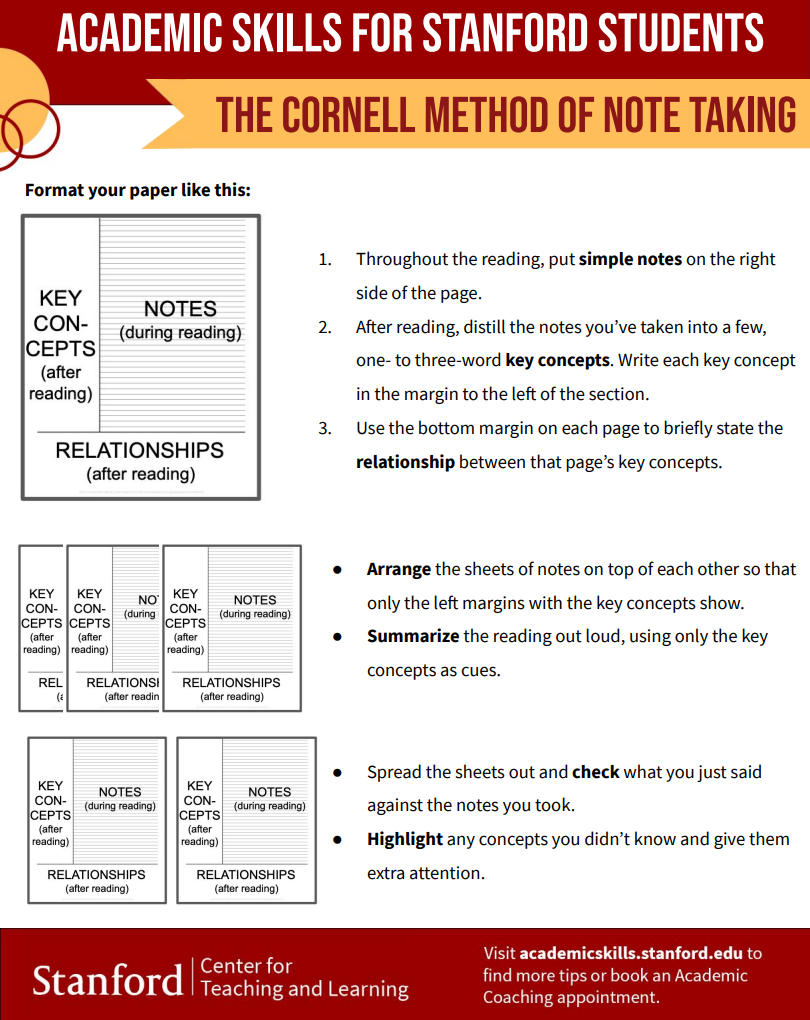
The Cornell Method of Taking Notes
Taken from stanford.edu.
Format your paper like this:
- Throughout the reading, put simple notes on the right side of the page.
- After reading, distill the notes you’ve taken into a few, one- to three-word key concepts. Write each key concept in the margin to the left of the section.
- Use the bottom margin on each page to briefly state the relationship between that page’s key concepts.
- Arrange the sheets of notes on top of each other so that only the left margins with the key concepts show.
- Summarize the reading out loud, using only the key concepts as cues.
- Spread the sheets out and check what you just said against the notes you took.
- Highlight any concepts you didn’t know and give them extra attention.